Credit Suisse — Designing Case Management at Enterprise Scale
How I designed and aligned internal Risk and Compliance platforms at scale, using prototypes to reduce fragmentation, improve case handling efficiency, and support a group-wide digital transformation.
Client
Credit Suisse
Service
User Experience (UX) Design
Date
May 2021 - April 2022

Project Overview
Role: Senior UX Design Consultant
Context: Internal Risk & Compliance platforms (KYC, onboarding, PEP, investigations)
Engagement: 6-month contract, extended to 12 months
Programme: Group-wide digital transformation for International Wealth Management
I joined Credit Suisse as a Senior UX Design Consultant to support a major digital transformation programme focused on Risk and Compliance. The mandate was clear: digitise and streamline complex internal processes while improving efficiency and reducing operational risk.
The work centred on large-scale case management platforms used by internal teams across the group, particularly within International Wealth Management. These platforms supported high-stakes workflows such as KYC, client onboarding, PEP identification, and compliance investigations — environments where errors are costly and ambiguity is dangerous.
Familiar problem space, unfamiliar scale
Coming from previous work on customer onboarding at HSBC and RegTech platforms at IMTF, the problem domain itself was not new. Designing case management systems for compliance-heavy contexts was familiar territory.
What was different was the scale and structure:
multiple parallel product squads,
overlapping mandates,
heavy governance,
and a constant tension between local optimisation and group-wide consistency.
There were eight product squads, each with its own product manager and focus area, and only two designers supporting all of them. Each squad was effectively building a variation of a case manager tailored to a specific use case.
Designing through prototypes, not documents
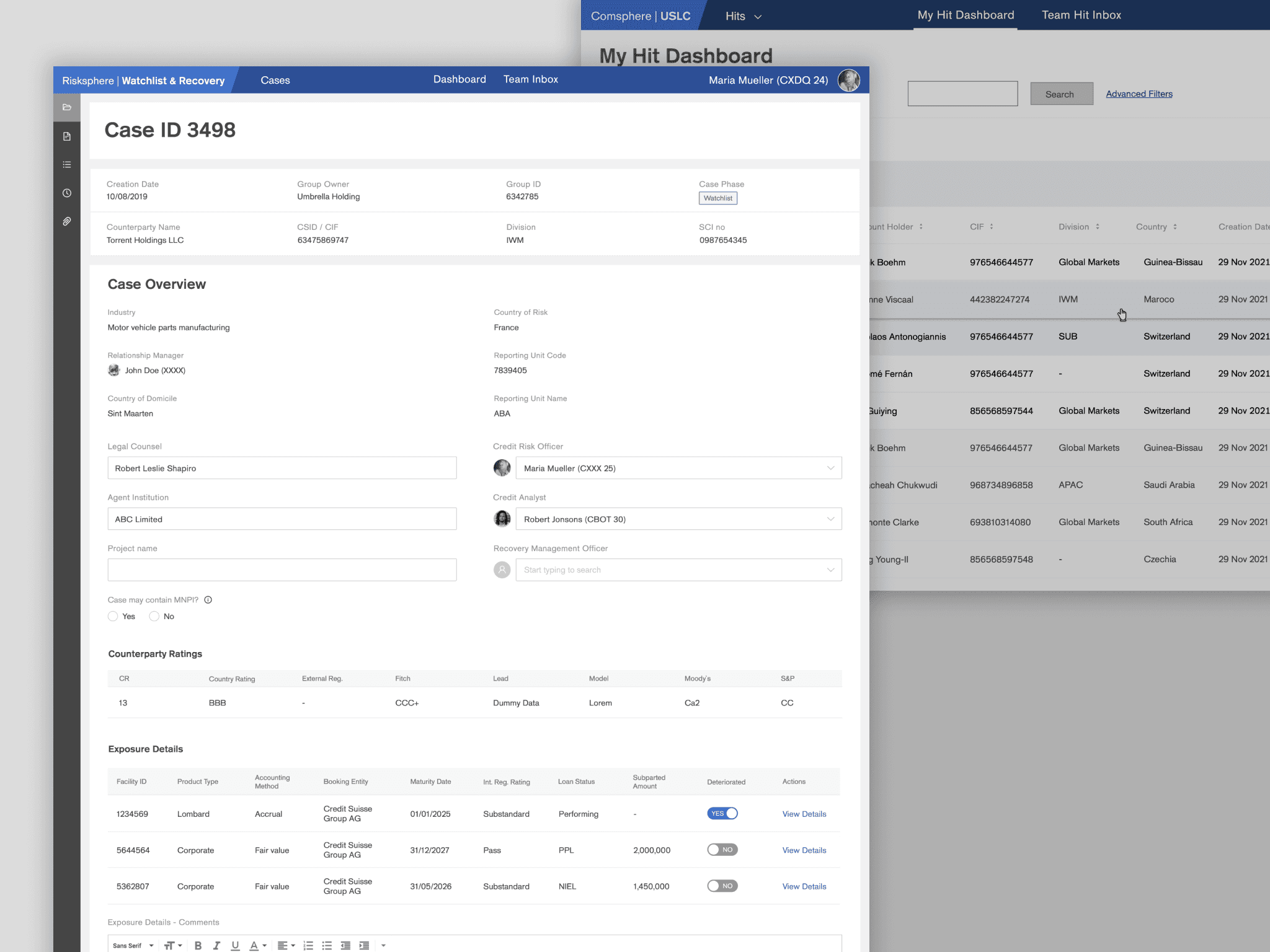
Given the complexity and pace, my primary output was not static documentation but interactive prototypes.
I worked closely with product managers across squads to translate requirements, regulations, and edge cases into tangible interaction models. These prototypes were used extensively for:
internal reviews,
stakeholder alignment,
and iterative validation with end users.
Because the users were internal employees of Credit Suisse, access was relatively straightforward. This allowed us to test early, validate assumptions quickly, and refine workflows continuously rather than relying on theoretical correctness.
The design focus was consistent across squads:
optimise efficiency for high-volume case handling,
reduce cognitive load,
minimise opportunities for error,
and make investigative state and decision history explicit.
In compliance work, clarity is not a “nice to have”; it is risk control.
Key Highlights
Navigating fragmentation while pushing for coherence
One of the core challenges was fragmentation. Multiple squads were solving similar problems in parallel, each under delivery pressure.
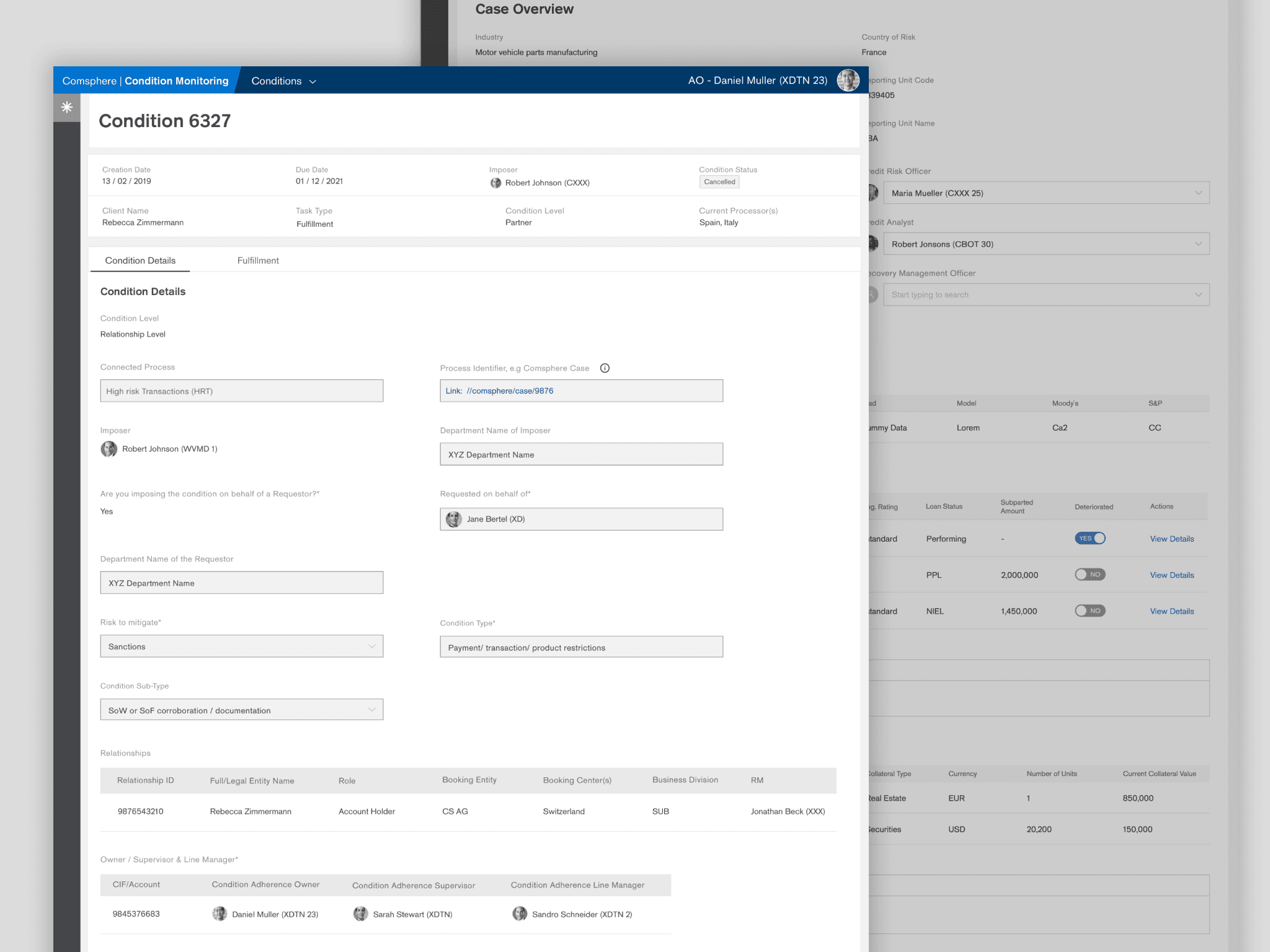
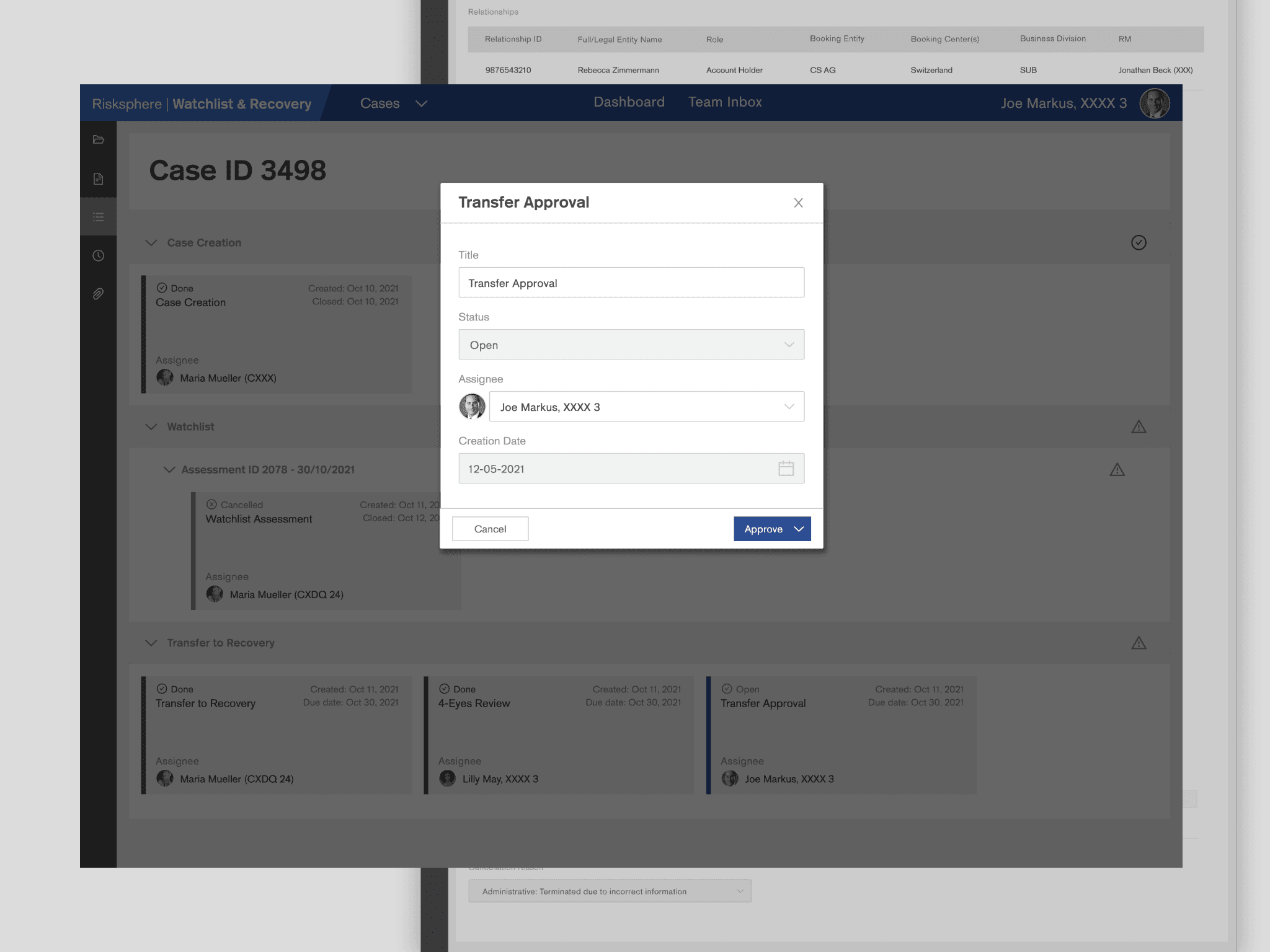
Alongside delivery work, I contributed to defining a shared design system for the case management platforms, helping establish common interaction patterns, layouts, and visual language. This work supported two major programmes:
ComSphere, focused on compliance teams,
RiskSphere, focused on risk teams.
The goal was not to enforce uniformity for its own sake, but to reduce inconsistency that increased training costs, user error, and maintenance effort. Even partial alignment had outsized impact at this scale.
Working inside constraints without becoming constrained
As a consultant embedded in a large organisation, my role required pragmatism. Decisions were shaped by regulation, legacy systems, governance, and delivery timelines. Influence mattered more than authority.
I operated in close partnership with product managers, using prototypes as a shared language to:
resolve ambiguity,
align stakeholders,
and keep discussions grounded in user workflows rather than abstract requirements.
Design here was less about ideal outcomes and more about directionally correct improvements that could actually ship.
Outcome and impact
Delivered validated interaction models for multiple case management use cases across Risk and Compliance.
Enabled faster alignment across squads through shared prototypes.
Improved clarity and efficiency in internal investigative workflows.
Contributed to the foundations of a shared design system across ComSphere and RiskSphere.
Supported a large-scale digital transformation programme with practical, delivery-focused design leadership.
Go Back

